

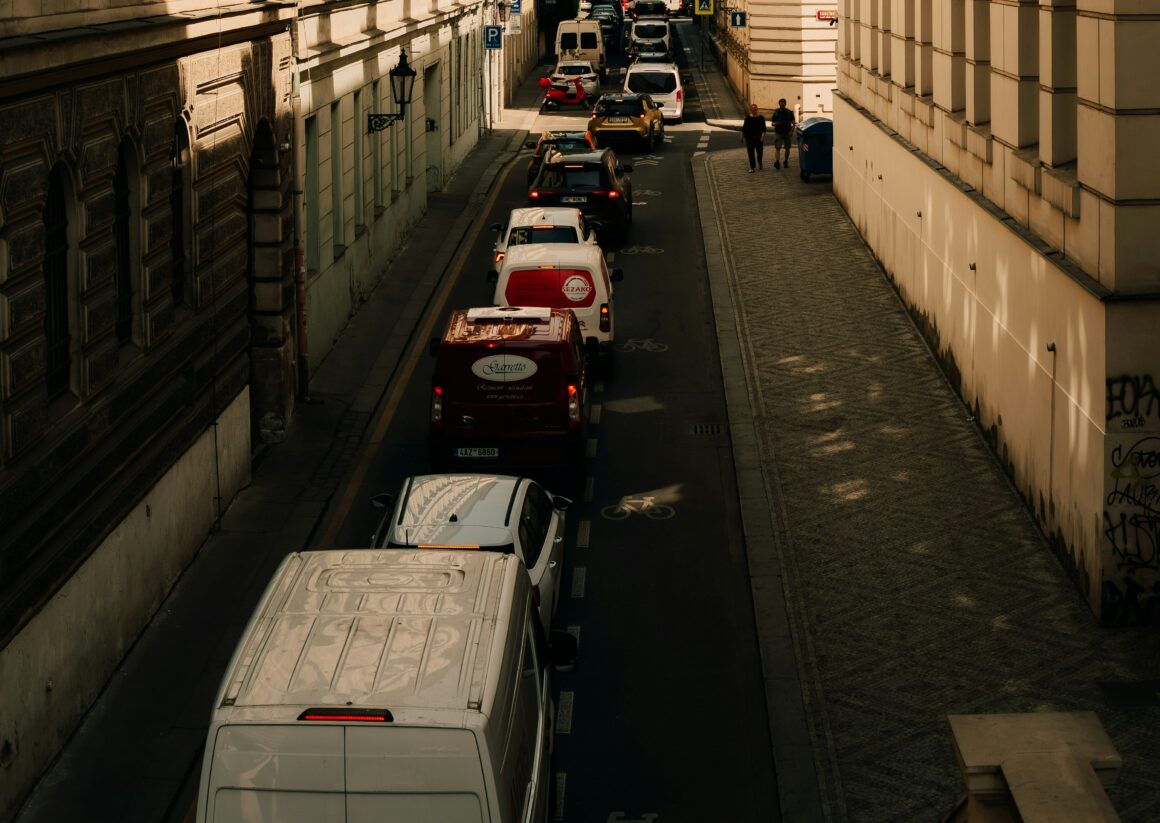
Prague performs poorly in European city rankings. It needs cleaner air and safer routes for walking and cycling, say AutoMat and Pěšky městem
Prague ranks among the worst-performing European cities in terms of air quality and measures to promote clean transport. In the new Clean Cities City Ranking 2026, Prague ranked 31st out of 40 cities assessed, receiving an E rating, the second-lowest grade. Bratislava and Vienna performed considerably better, ranking 19th and 9th respectively. According to the associations AutoMat and Pěšky městem, the results confirm that Prague needs to significantly accelerate changes to its transport system, particularly the development of safe walking and cycling infrastructure and the introduction of measures to reduce emissions from motor vehicles.
A new study by the European Clean Cities coalition assessed 40 major European cities based on current air pollution levels, compliance with stricter European air quality limits, progress over the past decade and the implementation of transport measures that can improve air quality in cities affected by heavy traffic. Prague scored just 24.2 out of a possible 60 points. It performed particularly poorly in the assessment of transport measures, scoring only one point out of ten.
The results reveal significant differences between European cities. Copenhagen, Stockholm and Helsinki performed best, being the only cities to meet all four of the stricter European air quality limits assessed. At the other end of the ranking were predominantly cities in Southern, Central and Eastern Europe, including Prague.
A total of 37 out of the 40 cities assessed would currently fail to meet at least one of the four new European air quality limits. These limits will apply from 2030, and EU Member States must transpose the relevant European directive into national legislation by 11 December 2026.
Low-emission zones
One effective tool for reducing air pollution from motor vehicles is the introduction of low-emission zones, which are already in place in London, Brussels, Warsaw, a number of German cities and the Bulgarian capital, Sofia. Prague, however, has yet to introduce a low-emission zone and does not even have an approved plan to establish one. AutoMat is also exploring the possibilities of introducing low-emission zones as part of the international project Central European Active Mobility Lab (CEAML) , working alongside the Slovak organisation Cyklokoalícia and other European partners.
“A key part of the solution is the development of continuous, safe walking and cycling infrastructure separated from motor traffic, enabling more people to choose active travel for their everyday journeys. Combined with low-emission zones and high-quality public transport, this can help us reduce car dependency and improve air quality on Prague’s streets,” says Michal Kalina from AutoMat.
Prague has protected cycle paths along just 9% of its main road network
According to the study, one of Prague’s most significant problems is the limited extent of its protected cycling infrastructure. Under the Clean Cities methodology, it covers just 9% of the main road network, the fifth-worst result among the cities assessed. In Vienna, the figure is 31%, in Berlin 44%, in the Belgian city of Ghent 40%, in Warsaw 45%, in Copenhagen as much as 73%, and in Antwerp 80%. Bratislava and Budapest also perform better than Prague, with protected cycle paths covering 16% of their main road networks in both cities.
The study specifically assesses infrastructure protected from motor traffic, rather than all cycle routes or cycle lanes marked with paint on the road surface. Prague failed to score a single point out of the two available for this indicator. According to AutoMat, the lack of a continuous network of protected cycle paths is one of the main barriers to the development of everyday cycling in the capital.
Isolated sections of cycle lanes that end at busy junctions or force people cycling to navigate heavy motor traffic cannot provide sufficiently safe conditions for children, older people or less experienced cyclists.
A safe journey to school as an indicator of a healthy city
The only point Prague scored out of a possible ten in the transport measures category was for the introduction of School Streets – measures that restrict motor traffic in the immediate vicinity of primary schools, particularly during the morning school run. According to the study’s methodology, however, only around 3% of primary schools in Prague currently benefit from School Streets. By contrast, School Streets are in place at 34% of schools in Paris, 27% in London and 26% of primary schools in Vienna.
A School Street is a simple traffic management measure that reserves the space outside schools during the morning rush hour for safe travel on foot, by bicycle or by scooter. School Streets give parents and children greater confidence in the safety of school surroundings, helping to foster children’s independence and healthy travel habits. In Prague, approximately 22% of children travel to school by car (Sustainable Travel to School survey, Pěšky městem, 2023). School Streets and safer school surroundings that encourage more people to choose active travel can therefore also help reduce overall traffic volumes on the city’s streets. The organisation Pěšky městem has helped introduce half of Prague’s existing School Streets.
“If we want to encourage children to choose active travel, we need to provide safe conditions for them to do so. Just one unsafe pedestrian crossing or another hazardous spot on the way to school is enough to make parents reluctant to let their children travel to school independently. School Streets help us improve traffic conditions around schools quickly and effectively,” says Petra Syrová, Chair of Pěšky městem.
The alarming figures from the Clean Cities study demonstrate that the commitment to sustainable mobility enshrined in the capital’s various strategic documents must not remain merely on paper but must translate into concrete measures.
Prague fails to meet any of the four new European air quality limits
The air quality measurements themselves are also cause for concern. Air pollution adversely affects residents’ health and poses a particular risk to children, older people and people with chronic health conditions. According to the National Institute of Public Health, 1,200 premature deaths among people over the age of 30 in Prague in 2025 can be attributed to cumulative exposure to fine particulate matter (PM₂.₅) and nitrogen dioxide (NO₂).
According to the study, Prague would currently exceed all four of the stricter European air quality limits for nitrogen dioxide (NO₂) and fine particulate matter (PM₂.₅), which will come into force in 2030.
The average concentration of NO₂ in Prague stands at 21.7 µg/m³, while the new European annual limit will be 20 µg/m³ from 2030. For fine particulate matter (PM₂.₅), the study reports a concentration of 13.5 µg/m³, which also exceeds the future limit of 10 µg/m³.
The study also compares cities in terms of the improvements in air quality achieved over the past decade. Here, too, Prague falls short of the best-performing cities. Although Prague has managed to reduce NO₂ concentrations by 29.1% and PM₂.₅ concentrations by 26.3% since 2016, some European cities are making considerably faster progress. Copenhagen and Stockholm, for example, have reduced NO₂ concentrations by 49.4%. The greatest reductions in PM₂.₅ concentrations were achieved in Sofia (54%) and Kraków (51%).
Change is possible
The study’s findings confirm that air quality is not an immutable characteristic of a city. Over the past decade, some European cities have managed to reduce NO₂ concentrations by more than a third, and in some cases by almost half. Successful cities combine a range of measures: low-emission zones and road charging, high-quality public transport given priority over other traffic, safe walking and cycling infrastructure, and traffic calming measures such as School Streets and sensible parking policies.
AutoMat and Pěšky městem are therefore calling on Prague’s new leadership to make the development of a continuous network of safe walking routes and protected cycle paths, the introduction of School Streets and preparations for low-emission zones genuine transport priorities.
Cleaner air and safer streets are part of the same transformation towards a city where people can travel safely, freely and in ways that benefit their health, without being dependent on cars.
Do you like what we do at AutoMat? Join us and become one of our supporters. Thanks!



Nakrmte AutoMat
Podpořte nás a staňte se tak členy Klubu přátel AutoMatu!